Showing posts with label India. Show all posts

Wednesday, May 25, 2016

QSRs in India : Fast Food, Faster Service, and Fastest Growth

Last fortnight during my whirling tour of Noida, Ghaziabad and Bhopal, I decided to visit some of my favorite malls which have been my favourite destinations of cooling down or spending some free time whenever I am in those cities. To my surprise, I noticed two common features across all the four malls I visited. First, many new shops had replaced the older ones and, second, the floors which had the food courts were more crowded with many new additional outlets. Customers were in queues at the outlets of both local and international brands starting from Pizza to Masala Dosa, and Burger to Daal Baati. I wondered has the days of quick service restaurants (QSRs) arrived in India? 

QSR, also known as fast casual eatery, usually serves foods faster and efficiently, and offers minimum table services. Quick service restaurants are usually chains of outlets with the same management, and their menu, food quality and price are standardized.  The brands which are most visible today in our country are McDonald’s, Domino’s Pizza, Pizza Hut, KFC, Papa John’s, Subway, Dunkin’s Donuts, etc. According to an estimated value of QSRs in India currently stands at over 8,500 crore and is expected to touch Rs. 25,000 crore by the year 2020. This growth projection is based on the ever increasing demand and is because of urbanization, changes in lifestyle and family structure, more and more disposable income, and higher propensity to spend for comfort, luxury, and tasty foods from across the globe. The above changes have tremendously helped the informal eating out (IEO) industry to grow and expand. 

A visit to the food court of any mall reminds you that India is a country of youth where more than 65% of its population is below the age of 40, who are working and are familiar with global cuisines. Seeing great opportunity in the Indian cities of different sizes (metro, tier I, II and III), number of international fast food brands are exploring the possibility of entry in Indian market. Varying business models like, complete ownership, franchisee, mix of ownership and franchisee, revenue sharing, etc., and with different levels of successes make it more attractive. many private equity investers are, therefore, finding it appropriate business to invest in. The format is also not complex and once the process is standardized, replication or scaling up becomes easier.  
The dominant QSR brands across the country are still ‘international’. Domino’s with about 1000 outlets leads the pack (KFC, Subway and Pizza Hut – about 500 each, and McDonald’s – 325). Besides having their respective brands, international QSRs  have a considerable edge over their Indian counter part because of their vast experiences across the globe in backend integration, centralized commissaries, distribution channels, vendor development, training of human resources and also because of capital. Currently, as per industry estimates, 60% of the total QSR market in India is dominated by foreign brands.

After being the leaders in local markets confined to small geographical areas for a considerable period, the Indian QSRs too are fast catching up. Brands like, Ammi’s Biryani, Kebab Express, Goli, Wah Ji Wah, Kaati Zone, etc. are expanding their reach to more and more cities.  The success of Indian QSRs is mainly because these outlets offer diverse menus which appeal to a cross section of customers, catering to their culture and taste. Secondly, the Indian offerings also provide a ‘stomach filling’ experience at comparatively lesser price. Also, as 80% of the QSRs are restricted in metro and Tier I cities of the country, its proliferation in Tier II and III cities will be a great opportunity for the Indian QSRs to tap. Further, it is expected that almost 35% of the 1.3 billion Indian will start living in urban areas by 2022. No doubt, international players are already moving to Tier II and III cities, and have started targeting the local population by offering new products which suit the local tastes at competitive price, but Indian companies will still have an edge because of their netter understanding of comparatively stronger food preferences of Indians. Now Indians have started eating out more frequently. According to The Associated Chambers of Commerce and Industry of India (one of the apex trade associations), as many as 50% of India’s population eats out at least once every three months and eight times every month in metros compared to the USA (14 times), Brazil (11 times), Thailand (10 times) and China (9 times). 

However, there are reports which do not present a very encouraging scenario for QSRs. Yum! which owns brands like KFC, Pizza Hut, and Taco Bell, reported sales decrease of 9% for its Indian division. The story of Nirula’s is also not very propitious. Increasing concerns for health and campaigns against junk food are likely to affect future growth of these outlets, provided they take proactive measures to develop new products or modify existing products to ones which are not considered as unhealthy junks. With increasing competition and ever changing food preferences, QSRs need to be very innovative to keep themselves in market. …which many of national QSRs have already proven.
As the food market has almost remained untouched by economic upheavals in the country, the QSR market is expected to grow at a rate much faster than that of the country’s economy and likely to remain the most important part of Indian food business.
Keep eating …and enjoying ! 

*****

Saturday, April 2, 2016

Indian Agriculture: Small is Not Inconsequential

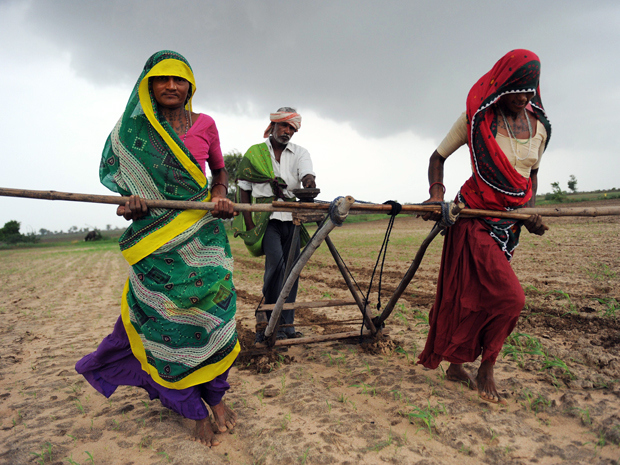
Thanks to the Annual Budget 2015–16, agriculture is once again on the agenda of every discussion about required policy interventions. The signals are clear – the government wants better returns for farmers by linking them to the market and by providing them with better infrastructure. Subsidies, in current form, are likely to go. The shift from subsistence farming to commercial farming is slowly becoming a reality and being considered as the major way out for improving the state of agriculture and farmers in country. The ‘Make in India’ philosophy of the government is encouraging the processing and marketing of agricultural products rather than direct consumption. Increasing marketability is the focus rather than increasing production. However, we, in India still face the challenges of numerical dominance of small and marginal farmers, and access of organized market to those small farmers. 

According to an estimate, more than 99% of the raw materials for industries are being produced by smaller farmers, and 90% of the marketed surplus is being handled by the private sector which, again, is dominated by the not so organized players. Lack of infrastructure, both for scientific production and for marketing of agricultural produce is a well known and well discussed issue.  And only 7% of agricultural produce are processed for further value addition. Now what options do we have by which most, if not all of the existing players in agriculture production and marketing are benefited?
The first answer has been tried in different parts of the country – contract farming. By definition contract farming is forward contract wherein the producer farmer agrees to produce and sell their produce having specified quality at agreed upon price to the processor/middle men/industry.  Unfortunately, in spite of many successful case studies it has failed to meet the market expectations. There could be different reasons however, small size of farms and large number of such farmers have been among the major factors considered responsible for not turning contract farming into a revolution. If successful, it has the potential of removing many limitations of Indian agriculture. 

Second, which is being encouraged by successive governments, is commercialization of agriculture. Commercialization makes agriculture production, processing and marketing riskier.  Seventy five percent of total contribution by agriculture in our GDP comes from the high value products. Higher costs of inputs mixed with lack of skills of using high valued inputs, inefficient processing because of inconsistent supply uniform raw materials, fluctuating prices of raw materials, comparatively less usage of improvised technologies in production and packaging, and challenges in marketing these perishable products with changing customers tastes make it too risky for everyone involved in the process. It can, however, be argued that this is not something specific to India and there have been similar conditions in many other countries. They however, have succeeded. Why can’t India overcome these issues? Unfortunately, assumption that as farmers’ paying capacity increases other supporting services like, information and advisory services, credits and banking, and insurance will cope and meet the farmers’ requirements is misleading one.  Sadly, failure of these services along with all ready dilapidated extension services resulted in series of many unwanted events like, crop failures, demand and price crash of many products, and ultimately farmer suicide. Small and marginal farmers who constitute the majority were the worst sufferers.
Lack of strategic investment in agriculture has been another concern. Although, overall expenditure including subsidies has been continuously rising but the money has not reached where it should reach: where it will have maximum impact. Expenditure because of subsidy on fertilizers, warehouses, cold storages, agriculture implements, are required and welcome but this cannot give us appropriate return on investment unless our farmers’ capacity is built to produce and market their produce efficiently. In spite of the ever spreading network of banks and increasing emphasis on financial inclusion in the country, only 15% of small and marginal farmers have their accounts in banks. Access to credit in most parts of the country is still a problem and dependence on money-lenders or trade middlemen makes agriculture a non-profit venture for most of the small farmers. 
Till now the major focus of removing rural poverty has been on agriculture. However, the country is witnessing changes in consumption patterns both in urban and rural areas. The demand is shifting towards protein based food like, milk and milk products, meat, poultry, vegetables and fruits from that of cereals. These rich food products have better production efficiency, return is higher than that from growing traditional cereals or millet based crops after investing the same amount of resources (manpower and economic). We have a successful cooperative model of Amul, which is not only inclusive but also provides access to market to individual livestock owners. Regrettably, we are not able to replicate the success of Amul for other products. 
Till the time, both, policy makers and the market stop looking at the small and marginal farmers as consumers, and start considering them as the partners, growth in agriculture will remain skewed in favor of large farmers. Although numerically stronger, small and marginal farmers lack negotiating power. Lack of information, resources, and negotiating power render them weaker in agriculture production, processing and marketing system.  If farmers and rural India has to be empowered and a “Make in India” campaign has to be successful, we just cannot then afford to ignore the small and marginal farmers who constitute 80% of total farming population.

****